

The five things that actually kill food biotech companies
Five recurring causes of death. Each one named, each one preventable, none of them new. Thursday's antidote to Tuesday's diagnosis.

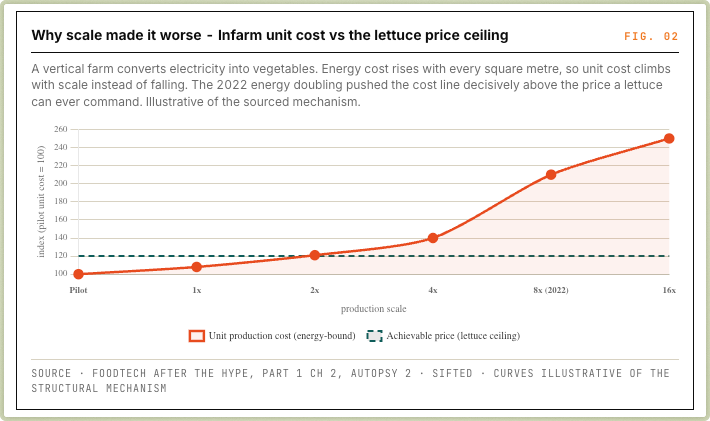
Infarm raised more than half a billion dollars. The plan was modular vertical farms inside supermarkets, fresh herbs grown where they are sold. The technology worked. The produce was good. None of that mattered. A vertical farm is a factory that turns electricity into vegetables, and the cost of electricity does not fall as you scale, it rises with every square metre you light.
The product was lettuce. Lettuce has a price ceiling a marketing team cannot lift. When European energy prices roughly doubled across the continent in 2022, the largest variable cost moved hard against the business. In November 2022 Infarm cut around half its staff. Through 2023 it abandoned Europe entirely, and its German, Dutch and UK entities were declared insolvent. The exit memo will tell you the energy crisis killed the company. It did not. The energy crisis revealed economics that were always negative. Capital had paid the difference for years, and called it growth.
On Tuesday I argued that most founders operate at a stage they have not earned. That is the diagnosis. This is the autopsy, and the antidote.
I have read a lot of food biotech post-mortems. The exit memos always reach for the weather. The funding winter. The conservative corporates. The slow regulators. Then you open the bank statements and the board minutes and you find the same five things, in almost every case.
They are not bad luck. They are structural, and structural means foreseeable, and foreseeable means preventable.
The Myth.
The myth is that companies die from external shocks.
The funding market turned. Energy prices spiked. A competitor raised a monster round. Retail delisted the category. These are the stories founders tell because they are the stories that do not implicate the operating model.
The shock is almost never the cause. The shock is the moment the structural problem becomes visible. Infarm’s unit economics were negative before the energy crisis. The crisis just removed the capital that had been hiding it. A company with sound economics absorbs a shock. A company that was default dead by design uses the shock as the cause of death on the certificate. The autopsy reads differently from the obituary.
The one move that changes the odds today
You cannot out-market the five killers and you cannot out-raise them. You out-design them, from day one, by running the autopsy on yourself before an investor runs it on you.
Here is the move. Score your company out of five against the killers below, this week, with your leadership team in the room and no narrative allowed.
Not “we are managing that.” A binary: is this killer live in this company, yes or no. Most food biotech deaths are visible roughly eighteen months before they happen. The founders who survive are not lucky and not smarter. They simply looked, early, while the answers were still cheap to change.
That habit, the self-run autopsy on a fixed cadence, is most of what separates the companies that are still here in 2028 from the ones writing their own exit memos.
